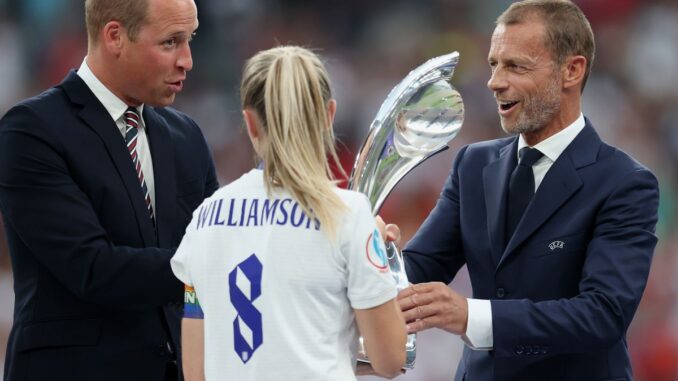
🎯 Context: The Moment It Happened
- The hug came at the final of UEFA Women’s Euro 2022, when the Lionesses beat Germany 2–1 at Wembley Stadium. That match gave England its first major tournament title in women’s football — and indeed the first major title for any England team since 1966.
- As captain, Leah Williamson played the full match and lifted the trophy on behalf of her team.
- After the victory and trophy presentation, images and video spread of Prince William — who is President (Patron) of the Football Association (FA) — congratulating players, including a warm, emotional hug with Williamson. That hug quickly became a defining image of the moment: a royal united in celebration with women footballers who had just made history.
Given the gravity of the win, the hug was more than symbolic — it came to represent recognition from the highest levels of British society for the achievements of women’s football, and an emotional bond between institution and athlete.
🗣️ What Leah Williamson Said — What Prince William Actually Said
In a post-match interview (on the England YouTube channel), Leah Williamson explained what went through her mind when she went to receive her medal — and what the Prince said just before giving her the hug. According to Williamson:
“I think I went to shake his hand and he said, ‘Leah, bring it in.’”
You can imagine the scene: after a chaotic, intense final — extra time, nerves, jubilation — the usual formalities of a medal presentation. Williamson approached to shake his hand, as protocol would normally dictate. But instead, Prince William beckoned her in for an embrace.
After that, she added:
She told me, “I’m very proud of you all.”
And Williamson recalled responding with:
“Thank you sir.”
❤️ The Emotional & Symbolic Weight of the Hug
Why did that moment — beyond the fact of victory — resonate so deeply with fans, players, and social commentators? There are several layers.
• Royal Recognition for Women’s Football
For many years, women’s football suffered from under-recognition, underfunding, and societal undervaluing. For a figure representing both national institution and monarchy (Prince William) to publicly embrace the England women’s captain was a powerful symbolic endorsement. It signified — in a single gesture — respect, pride, and validation.
That hug sent a message: you matter. That even as the Lionesses made history on the pitch, their achievement would also be honoured off it — not just with a trophy and medals, but with human warmth and dignity.
• Emotional Resonance and Human Connection
Williamson later acknowledged the hug meant a lot to her, not only as a player but as a person. The warmth, the sense of being seen in that moment — it broke the barrier between “elite athlete receiving trophy” and “human being sharing a victorious, liberating celebration.”
In the aftermath of the match, that image and that story resonated widely across social media, traditional media, and fan communities. Many viewed it as a rare display of public empathy and support — the kind that echoes more with heartfelt sport than formal ceremony. As one commentator described it, the gesture was “typical Diana,” referencing the late Princess Diana — with her legacy of warmth and closeness to people — underscoring how rare and meaningful such a public hug from royalty remains.
• A Defining Memory of Euro 2022
For the Lionesses, that tournament changed everything. But for Williamson — as captain — the hug, the words, the public embrace, the sense of pride and national recognition: those elements made her emotions that day something more than just “winning.” It became a milestone — in her career, in women’s sport, in cultural recognition. The hug served as a tangible reminder that their achievements were being acknowledged not only as athletes, but as national icons.
🔎 Broader Significance: What It Reflects About Women’s Football, Royalty & Culture
That single exchange — “Leah, bring it in,” followed by “I’m very proud of you all” — encapsulates much larger themes and ongoing developments.
1. Growing Respect for Women’s Sport
The success of the Lionesses at Euro 2022 marked a turning point for women’s football in England (and beyond). It wasn’t just about winning — it was about changing perception. The hug from Prince William acted as a symbolic seal of that changed perception: women’s football had earned not only trophies, but respect.
In subsequent years, the spotlight on women’s football has only grown — increased viewership, contract improvements, better media coverage, more youth interest. The moment highlighted how far the sport has come, and how symbolic gestures can reinforce that progress.
2. Royal/Institutional Endorsement & the Intersection of Sport and National Identity
The involvement of royalty in sport — especially royalty publicly hugging athletes — has a history and weight. For centuries, royal patronage has lent legitimacy to institutions and endeavours. In this case, the hug symbolized institutional support from a national body — the FA — and implicit endorsement by the monarchy.
It underscored that the Lionesses were not just “another team,” but ambassadors for national pride, progress, and sporting evolution. That kind of visibility matters — especially for young girls watching, for aspiring athletes, for society’s broader view of what women’s sport can — and should — represent.
3. The Power of Human Moments in Professional Sport
Sport is often described in stats: goals scored, trophies won, records broken. But sometimes what people remember most are the human moments: tears, hugs, raw displays of emotion, connection. That hug — simple, personal, heartfelt — reminds us that beyond athletic prowess, sport is about human stories, shared joy, collective identity.
It also shows that such moments can ripple far beyond the pitch: inspiring social media, influencing public perception, shaping narratives about gender equality, empowerment, and national pride.
✨ What Leah Williamson & the Team Took from It
In the aftermath, Williamson didn’t just celebrate a win — she recognized what the win symbolised for women’s sport, for the country, for future generations. As she said after the final:
- She felt “proud to be English,” and humbled to lead 23 women who had just made history.
- She emphasised that regardless of playing time, simply being part of the squad meant a lifelong bond with her teammates.
- The validation of the hug — of being congratulated in a genuine, human way — added to the sense of achievement, belonging, inclusion.
For many players, such a moment remains more vivid than any stat or goal — because it affirmed they belong, they are seen, they are valued.
🧠 Why This Moment Still Matters in 2025
Even years later, amid newer tournaments, evolving squads, and shifting public interest, the 2022 final — and that hug — remains a symbolic bedrock for women’s football in England. Here’s why:
- It serves as a reference point: the moment when the Lionesses weren’t just winners, but national symbols. That success and recognition inspire younger generations of girls to dream of football careers.
- It changed public attitudes: after 2022, there was a surge of respect and support for women’s football, from fans, media, sponsors, institutions. The hug humanised and legitimised that transformation.
- It continues to influence how institutional bodies — clubs, associations, national institutions — treat women’s sport: not as an afterthought, but as a central, valued pillar.
As of 2025, with ongoing tournaments, growing audiences, and increasing visibility, that moment remains a touchstone — a reminder of what was achieved, and what’s still possible.
🔎 Some Reflection — What We Should Remember, What We Should Question
While the hug and congratulatory words were meaningful, it’s also important to reflect on what they represent — and what they do not guarantee.
- A hug, however powerful, does not automatically translate into long-term structural change (e.g. equal pay, equal funding, equal visibility) — though it can help shift public sentiment. Symbolic gestures are important, but need to be backed by sustainable action.
- For players, emotional validation is distinct from stability: careers in women’s football (especially historically) have been precarious, underpaid, undervalued. Moments of recognition are vital — but so are consistent investment, support systems, career security, development pathways.
- For institutions: public support (from royalty, media, fans) brings visibility — but institutions must follow through: ensure resources, opportunities, equity. Without that, the symbolism risks being superficial, transient.
📝 Final Thoughts: A Hug That Echoes Beyond the Trophy
The words that passed between Prince William and Leah Williamson — “Leah, bring it in” … “I’m very proud of you all” — were simple. But in that simplicity lay a profound acknowledgment: of effort, achievement, history, progress.
For Williamson, for the Lionesses, and for women’s football — the hug was a human embrace that validated more than just a victory. It validated a long journey, a fight for respect, a changing cultural moment, and hope for a future where women’s sport stands equal.
Years from now — when trophies fade, players retire, squads evolve — that picture, that moment, will still carry weight. Because sometimes what we remember most isn’t the goal, the win, or the statistic — but the hug, the human moment, the acknowledgement.
Leave a Reply