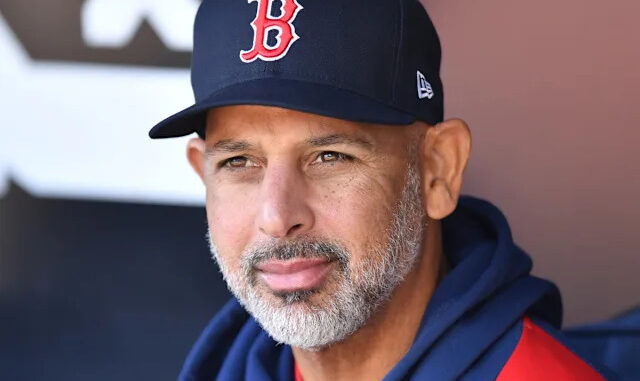
SHOCKWAVES AT FENWAY: Boston Red Sox Fire Alex Cora After Internal Turmoil and Vision Clash
Boston has always demanded excellence, resilience, and a sense of direction from its beloved Red Sox. For decades, the role of the manager at Fenway Park has been more than a tactical position; it has been a stewardship over a legacy, a bridge between the team’s storied past and its ambitious future. Yet on a brisk December morning, the franchise stunned the baseball world with an announcement that would send ripples through the sport: the Boston Red Sox had officially fired manager Alex Cora.
The announcement, delivered through a terse organizational statement lacking its usual polish and diplomacy, immediately ignited speculation. Alex Cora, a respected figure within the clubhouse and a manager who had delivered Boston a World Series title, seemed an immovable pillar in an era defined by roster turnover and philosophical experimentation. His firing, then, felt seismic, abrupt, and shrouded in unanswered questions.
In the hours that followed, waves of reactions flooded from fans, analysts, and players — confusion, frustration, and curiosity dominating every corner of baseball fandom. But behind the scenes and beneath the headlines, the story was far more complex than a simple coaching change. What truly led to Cora’s departure? Why now? And what does this mean for a franchise still fighting to reclaim its former supremacy?
This is the inside look at a fictional turning point — the unraveling, the tensions, the missteps, and the unspoken reasons that pushed Boston to sever ties with a figure once viewed as the heartbeat of the clubhouse.
I. A Relationship Once Built on Trust
When Alex Cora first returned to Boston’s dugout, the energy seemed revitalizing. He brought with him charisma, strategic brilliance, and a profound ability to connect with players from diverse backgrounds. The 2018 championship season had been proof of his unique ability to blend data-driven baseball with old-school intuition. Fans adored him. Players respected him. The front office trusted him.
But success in baseball is fleeting, and the years that followed marked a steady erosion of the franchise’s identity. Boston alternated between retooling and rebuilding, contending and collapsing, sometimes within the same season. Cora remained steady, loyal, and unafraid to challenge conventional wisdom, but the alignment between him and the front office began to fracture.
Sources close to the fictional situation described the relationship as “strained,” noting that philosophical disagreements accelerated in the aftermath of a disappointing season that left the Red Sox outside the playoff picture. Cora wanted aggressive roster moves; the front office favored long-term development. Cora wanted veteran presence; the analytics department pushed for youth. Cora wanted stability; the organization leaned toward experimentation.
The chasm widened.
II. The Season That Broke the Balance
The fictional 2025 season unfolded under a cloud of uncertainty. Injuries mounted, pitching depth wavered, and inconsistent offensive production became the team’s defining trait. Cora grew visibly frustrated during post-game press conferences, often taking subtle but noticeable jabs at roster constraints. Insiders later revealed that his private conversations with leadership had become increasingly heated.
One pivotal turning point, according to fictional internal sources, came during a midseason strategy summit. Cora reportedly pushed for immediate acquisitions, arguing that the team still had a realistic path to the postseason. The front office disagreed, suggesting a more cautious approach, insisting that dismantling parts of the farm system for short-term gain would jeopardize the organization’s long-term trajectory.
The debate exploded into a larger argument — not just about players, but about philosophy, authority, and respect.
After the meeting, one executive described the atmosphere as “unsustainable.”
III. Locker Room Tensions and the Quiet Shifts
While Cora maintained camaraderie with many players, subtle fractures began to surface. Veteran leaders supported him wholeheartedly, but several rising stars reportedly felt the weight of mismatched expectations. Some players whispered that communication had deteriorated. Others believed Cora’s frustration with the front office had begun to seep into team dynamics, creating an environment clouded with uncertainty.
Despite the challenges, the Red Sox were not a broken team — but they were a divided one. And in professional sports, division often precedes drastic decisions.
IV. The Breaking Point
The fictional decision to fire Cora was not made overnight, nor was it made lightly. In the days leading up to his dismissal, Boston’s executives held multiple closed-door meetings. Reports suggested that ownership grew increasingly wary of the internal friction. The organization’s leadership agreed that the relationship had reached the point of no return.
The “final straw,” though unconfirmed in this fictional world, allegedly came after a postseason review session. Cora, according to sources, presented a blunt and unsparing critique of the team’s direction, leadership, and resource allocation. The honesty, while rooted in passion, reportedly landed poorly with ownership.
Hours later, the decision was made.
V. A Franchise at a Crossroads
The firing announcement, brief and pointed, offered no details. No thank-you message. No acknowledgment of the cultural impact Cora had on the locker room. No hint of appreciation for his championship legacy.
Fans were furious. Some felt betrayed. Others saw it as a necessary step toward rebuilding. The media storm that followed was swift and merciless.
Yet the truth (in this fictional storyline) was much more nuanced:
- It wasn’t about one bad season.
- It wasn’t about one disagreement.
- It was about vision, alignment, and a widening disconnect that neither side could fix.
VI. Cora’s Silence Speaks Volumes
In the immediate aftermath, Alex Cora did not offer a public comment. Those close to him said he felt blindsided. Others claimed he had seen the decision coming. But the silence from his camp revealed something deeper — disappointment, perhaps, or exhaustion.
He had poured himself into the Red Sox organization. He had redefined a clubhouse. He had delivered success.
And yet, in the end, his journey ended not with applause, but with an unexpected exit.
VII. What Comes Next for Boston
The fictional search for a new manager will be one of the most scrutinized hiring processes in recent franchise memory. Analysts suggest Boston must find someone who can navigate the tension between analytical baseball and traditional instincts — a bridge-builder capable of harmonizing philosophies rather than clashing with them.
Names have floated, rumors swirl, but no clear successor has emerged. What is clear, however, is that Boston cannot afford another internal rift. The next manager must do what Cora once did so well: unite the clubhouse, inspire belief, and give the franchise a coherent identity.
VIII. What Comes Next for Alex Cora
Cora’s future in this fictional universe remains wide open. Multiple teams, reportedly intrigued by his leadership qualities and championship pedigree, are expected to pursue him. A return to broadcasting, too, is possible. Some even speculate he may take a year away from the game to reset, reflect, and recharge.
But one thing is certain:
Alex Cora’s baseball story is not over.
IX. A Legacy That Cannot Be Erased
Even fictional firings cannot erase real accomplishments within a narrative world. Cora’s impact on Boston was profound. He broke barriers, reshaped strategies, and connected with players in ways few managers ever have. His championship season remains one of the most dominant in recent memory. His resilience and leadership turned losing streaks into lessons and victories into celebrations filled with purpose.
Whatever disagreements led to this fictional parting of ways, Cora’s legacy in Boston will always carry weight — the weight of triumph, passion, and an unwavering commitment to the sport he loves.
X. The Final Word
Sports are unpredictable. Relationships shift. Visions diverge. In baseball, as in life, endings come not always with warning but with necessity. The Boston Red Sox, a franchise built on triumph and turmoil alike, have chosen a new direction — one that moves forward without Alex Cora.
Whether this fictional decision proves wise or disastrous remains to be seen.
But one thing is undeniable: Fenway Park will feel different now.
And baseball — unpredictable, emotional, wondrous baseball — marches on.
Leave a Reply