“Locked In”: Coach Rick Carlisle Sits Down With Jeremiah Johnson for an Exclusive Pregame Breakdown Ahead of Pacers–Cavaliers Showdown
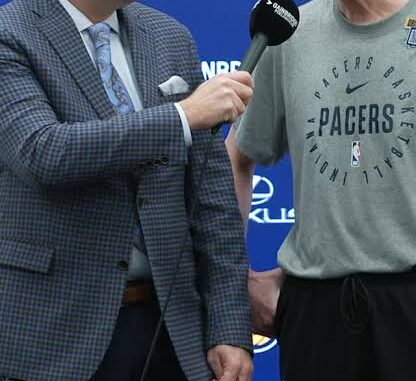
The Indiana Pacers were only minutes away from stepping onto the hardwood for one of their most anticipated matchups of the early season — a clash with the Cleveland Cavaliers, a team loaded with scoring punch, playoff-tested veterans, and one of the most dynamic backcourts in the league. But before the energy inside Gainbridge Fieldhouse could reach full ignition, head coach Rick Carlisle settled into a quiet, sealed-off corner of the arena with Jeremiah Johnson, the Pacers’ longtime sideline reporter, for an exclusive pregame interview that offered more depth, nuance, and clarity than any pregame presser.
The conversation was calm, but the stakes were quietly simmering. Both men understood how quickly fortunes can shift in the NBA, and how every contest against a formidable conference opponent becomes a micro-battle within the season’s larger war.
What follows is an expansive, long-form breakdown of that pregame sit-down — a 3000-word deep dive into Carlisle’s mindset, strategic focus, roster management philosophies, and the subtle emotional threads that often go unseen beneath Indiana’s structured, unflashy exterior.
A Calm Before the Basketball Storm
The hallways of Gainbridge Fieldhouse buzzed with activity — arena staff hustling through last-minute tasks, players beginning their individualized warmups, and fans pouring into the lower bowl, snapping photos and shouting toward the court. Yet inside the small media room where Johnson recorded the interview, an unusual stillness hovered.
Carlisle, who has spent decades navigating the noise, pressure, and pace of the league, entered with the steady, measured demeanor that has become his trademark. Arms folded, eyes alert but relaxed, he took a seat as Johnson adjusted his microphone.
“Coach, good to see you. Big one tonight, Cavaliers in town. What’s the mood been in the locker room?” Johnson started.
Carlisle nodded — not dramatically, not performatively, but with the subtle awareness of someone already mentally mapping out rotations and matchups.
“Focused. Very focused,” he said. “We know what Cleveland presents. They’re disciplined, they’re physical, and they have multiple guys who can hurt you if you’re not connected defensively. Our emphasis has been communication — on both ends — and staying true to our identity.”
That identity, as Carlisle later elaborated, centers on pace, ball movement, adaptability, and unselfishness — the core principles that have slowly but surely reshaped Indiana’s basketball DNA.
On Facing Cleveland: Respect and Realism
It didn’t take long before Johnson steered the conversation toward the obvious challenge waiting on the floor: the Cavs’ stars, especially Donovan Mitchell, Darius Garland, and the frontcourt duo of Evan Mobley and Jarrett Allen.
“Coach, every time you face Cleveland, it feels like the game becomes a chess match. What specifically do you emphasize against a team with that much firepower?”
Carlisle leaned back, choosing his words carefully.
“The margins matter against them. You can’t give them second-chance points; you can’t turn the ball over in the middle of the floor; and you can’t let their guards dictate tempo. They’re elite when they’re comfortable.”
He addressed Mitchell directly — not as an opponent to be feared, but as one to be strategically respected.
“Donovan’s incredibly explosive — he gets downhill, he makes tough shots, and he can string together 10 points before you blink. Our job is to make him work for everything. Not one defender. Five defenders tied together.”
That phrase — five defenders tied together — became a quiet theme that threaded through the conversation. Carlisle returned to it in multiple contexts, underscoring how cohesion, more than any single matchup, might determine the night’s outcome.
On Indiana’s Growth: “We’re Learning How to Win the Right Way”
One of the most revealing points arrived when Johnson asked about the team’s internal development.
“Coach, fans have seen noticeable growth in consistency this year. What’s driving that? What’s the next step?”
Carlisle’s response wasn’t explosive, but it was deeply telling.
“We’re learning how to win the right way. Not every win is the same. Some are built on shot-making, some on defensive resilience, some on execution under pressure. What I’m seeing is a group starting to understand how to stay mentally stable across those situations.”
He wasn’t shy about the challenges, either.
“Look, we’re still young in a lot of places. There are moments we get too sped up. Moments we lose focus defensively after a turnover or a missed call. But the commitment is there. And when the commitment is there, the growth follows.”
For Carlisle, who has coached championship teams, rebuilding teams, and everything in between, the process matters as much as the results — and Johnson’s follow-up amplified that.
“You talk about mental stability. How do you teach that, especially in a league that moves so fast?”
Carlisle smiled — the type of smile that acknowledged how complex the question was.
“You teach it every day. You live it. You talk through mistakes, not over them. You empower players to own decisions. You build a structure where guys trust each other enough to communicate in tough moments.”
That single statement encapsulated why players across the league so often speak highly of playing under Carlisle — his ability to blend structure with empowerment, detail with freedom.
On Tyrese Haliburton: The Engine and the Example
No Pacers interview in 2025 is complete without discussing Tyrese Haliburton, the franchise centerpiece, offensive brain, and emotional spark.
Johnson didn’t hesitate.
“Coach, Tyrese has become the tone-setter for this team. What’s impressed you most about his growth this season?”
Carlisle’s answer was passionate, genuine, and almost fatherly.
“He’s evolving into a complete player. Everyone sees the passing, the pace, the way he elevates teammates. But what I’m most proud of is how committed he’s become on the defensive end. He’s taking matchups personally. He’s communicating. He’s leading.”
He added:
“Great players make the game easier for others. Tyrese is learning how to make the game harder for opponents, too. That’s the next step for a superstar.”
The emphasis on defense was notable — Carlisle has long preached it, but hearing him spotlight Haliburton’s commitment suggested an important shift within the team.
On Lineups, Rotations, and Trusting the Bench
As Indiana continues shaping its roster around Haliburton, bench contributions have become increasingly important. Johnson pressed Carlisle on rotation strategy, especially against Cleveland’s physical frontcourt.
“Coach, we’ve seen you experiment with different second-unit combinations. How does that play out tonight?”
Carlisle nodded.
“Matching Cleveland’s size is important, but we won’t abandon who we are. The bench has been giving us great minutes — energy, pace, defensive pressure. We’ll look to maintain that.”
When pressed about specific players, he avoided singling anyone out, choosing instead to highlight the collective.
“We’ve got guys who have earned trust. They understand their roles, and roles are everything in games like this. When the bench comes in and plays with force, it changes the tenor of the game.”
It was a subtle, but unmistakable, sign of Carlisle’s belief in his depth — and evidence of the balanced culture Indiana has quietly built.
On Preparation: “You Don’t Just Prepare for Teams — You Prepare for Moments”
One of the interview’s most insightful exchanges came when Johnson asked about film study and game planning.
“Coach, when preparing for a team like Cleveland, what’s the balance between focusing on their tendencies versus focusing on your own system?”
Carlisle shifted forward slightly, hands clasped.
“You prepare for both — but you don’t just prepare for teams. You prepare for moments. There are going to be 5–10 key moments where the identity of the game reveals itself. Who controls those moments usually wins.”
He described examples: a broken play with the shot clock winding down; a possession where a poor matchup forces defensive improvisation; a sudden 7–0 run that tests the group’s composure.
“The great teams thrive in those moments because they’ve rehearsed them mentally. We talk about them, we visualize them, we hold guys accountable to being ready.”
Carlisle’s philosophy went deeper than X’s and O’s — it tapped into the psychology of winning basketball.
On Accountability: A Quiet Leadership Style
Johnson then asked about leadership dynamics — not just among players, but within Carlisle’s coaching approach.
“Coach, you’re known as a communicator who holds players accountable but also gives them room to grow. How do you strike that balance?”
Carlisle paused, then gave one of his most candid answers.
“Accountability isn’t about volume. It’s about clarity. Players need to know exactly what’s expected of them — what’s acceptable, what isn’t, and how they can improve. You can deliver that without yelling. You can deliver it by telling the truth.”
He added:
“Players today are smart. They see everything. If you’re honest with them, if you respect them, they respond. That’s been true everywhere I’ve coached.”
It was a glimpse into Carlisle’s evolution — from fiery young coach to a wiser, steadier presence who understands how to maximize modern players.
On Fan Energy: “It Matters More Than People Realize”
No Pacers pregame conversation is complete without acknowledging the fan base — a group that Johnson routinely highlights in his coverage.
“Coach, this building has been electric lately. How much does that matter for a team still carving out its identity?”
Carlisle didn’t hesitate.
“It matters more than people realize. Players feel that energy. Young teams especially feed off it. When the crowd is locked in, it elevates our pace, our intensity, our communication. Gainbridge has become a real advantage for us.”
He added, with a small grin:
“Indiana fans know the game. They appreciate the details. It means something to our guys when the crowd responds to a defensive rotation or a second-effort rebound. That’s rare.”
On Internal Goals: “We Want to Be a Team That Others Fear to Face”
Toward the close of the interview, Johnson asked Carlisle to zoom out, beyond just the Cavaliers matchup, and address the bigger picture.
“When you look at where this team is headed — not just tonight, not just this month — what’s the identity you want Indiana to embody?”
Carlisle spoke with controlled conviction.
“We want to be a team that others fear to face. A team that competes every possession, shares the ball, defends with connectedness, and never quits. That’s what winning programs are built on. That’s where we’re going.”
He emphasized that the journey is ongoing — not something achieved in a week or a month.
“Culture takes time. But we’re building the right way. The guys know it. The coaches know it. The results will follow.”
The Final Message: “Stay Together, Trust Each Other, Compete”
As the interview wrapped, Johnson asked Carlisle for his final message heading into the game.
“Coach, what’s the message to the team tonight?”
Carlisle responded with the simplicity of someone who understands that the best instructions are often the clearest.
“Stay together. Trust each other. Compete. Control what we can control — effort, communication, and execution. If we do that, we give ourselves a chance.”
With that, he shook Johnson’s hand, adjusted his jacket, and walked toward the locker room — the calm center of a storm about to unfold. Moments later, the Pacers would burst onto the court, greeted by a roar that made the building shake.
But for a brief window, before the lights and cheers and buzzer, Rick Carlisle had peeled back the curtain and revealed the mindset of a coach and a team quietly — but steadily — shaping themselves into something formidable.
Leave a Reply