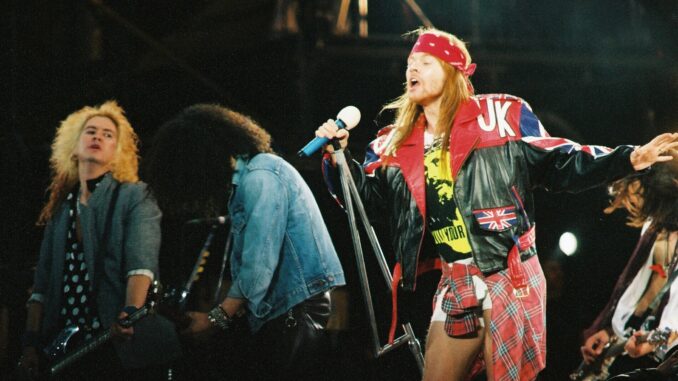
Below is a deep dive: what is known about their tours, what is rumored, what history suggests about a potential joint “final” tour, what such a tour might look like (speculatively), and how fans are reacting. If you like, I can also draft a hypothetical schedule of what a Metallica / Guns N’ Roses “final world tour” would look like, based on current tour patterns.
What is known (as of October 2025)
Metallica’s current and upcoming tour plans
- Metallica is in the midst of their M72 World Tour, which began in 2023 and is projected to run through 2026.
- The tour supports their 2023 album 72 Seasons.
- As part of their strategy, they often perform “No Repeat Weekend” legs (i.e., playing two nights in a city with different setlists).
- Metallica has also announced new European/UK tour dates for 2026, with support acts such as Gojira, Knocked Loose, Pantera, and Avatar.
Thus, Metallica is clearly active and planning an extended touring timetable.
Guns N’ Roses’ 2025 tour
- Guns N’ Roses announced a major 2025 world tour called Because What You Want & What You Get Are Two Completely Different Things Tour.
- That tour begins May 1, 2025 in Incheon, South Korea, and is scheduled to conclude November 8, 2025 in Mexico City.
- The tour includes Asia, the Middle East, Europe, and then later Latin America.
- Additional dates were added for Latin America (October–November) following the success of the first leg.
- The band is also using a new drummer (Isaac Carpenter) for this tour after the departure of longtime drummer Frank Ferrer.
So, Guns N’ Roses is also fully committed to a global schedule in 2025.
Previous joint or co-headlining history
- In 1992, Metallica and Guns N’ Roses embarked on a co-headlining stadium tour across the U.S. That tour is infamous in rock lore for various controversies, including James Hetfield’s pyrotechnics injury and a subsequent riot when Guns N’ Roses cut their set short.
- That 1992 tour is often cited when media discuss a potential joint tour now, especially given the history and the “what could have been” narrative.
- However, beyond occasional festival appearances or shared billing on large festivals (e.g., they were among the heavy artists on “Power Trip” festival in 2023) , there has been no credible recent announcement that they are doing a new full-scale co-headlining tour, let alone a “final” one.
The unverified “final joint tour” claim
- There is a post circulating (for instance, in a Facebook group) claiming “Metallica and Guns N’ Roses Announce Epic Final Joint Tour – Dates and Cities Revealed”
- But I was unable to find reliable coverage from major music publications (Rolling Stone, Billboard, etc.) or from the official band websites confirming this.
- The official websites (such as Guns N’ Roses’ News page) currently list their 2025 tour dates (as above), but no mention of a joint tour with Metallica.
- Until a credible source emerges, this remains a rumor or unverified claim.
Thus: as of now, there is no confirmed evidence that a “final joint tour” is real.
Why such a tour is plausible (and why it might be improbable)
Arguments in favor
- Legacy appeal & finality
— Both bands are in their 40+ year careers. A “farewell tour” co-headlined by two of the most influential rock/metal bands would generate massive buzz and ticket sales.
— It taps into nostalgia; many fans now are longtime followers who would relish one last chance to see both. - Synergy and mutual respect
— Despite past conflicts, both bands have mutual respect. A joint tour signals a coming together, and would be a powerful statement in rock history.
— The “reunion/reconciliation” narrative sells well. - Logistical and touring momentum
— Since both are touring actively (Metallica in 2026, Guns N’ Roses throughout 2025), their schedules might align in a future window.
— The infrastructure (stadiums, promoters, global circuits) is already in place, so a joint run is feasible with the right coordination.
Arguments against
- Creative and ego differences
— The two bands have very different artistic styles, fanbases, priorities, and managerial approaches.
— In 1992, clashes over show order, set times, delays, technical demands, and ego-driven excesses contributed to major friction.
— For a new joint tour to succeed, those issues would need to be controlled. - Scheduling conflicts & commitments
— Metallica is already committed to the M72 tour extending into 2026.
— Guns N’ Roses’ 2025 schedule is very full.
— It may be hard to carve out a joint window, especially with the logistical demands of stadium tours. - Financial demands & risk
— Splitting revenue, production costs, staging, crews, routing—all of these are complex and expensive.
— If one band’s draw lags in certain markets, it might cause imbalance. - Rumor vs. reliable source caution
— Because music news often spreads by rumor, many “announcements” online are hoaxes or speculative marketing.
— Bands and promoters usually coordinate press releases, ticketing announcements, branding; nothing of that sort has reliably surfaced.
In summary: while a joint “final tour” is an attention-grabbing idea and not impossible, it’s far from confirmed.
What a “final joint tour” might reasonably look like (speculative)
If we imagine that Metallica and Guns N’ Roses do launch a final joint stadium world tour, here’s how it might be structured, given patterns, history, and fan expectations.
Tour structure & routing
- Global stadium circuit: North America → Latin America → Europe → Asia / Australia → Middle East / Africa
- Duration: 1.5 to 2 years
- Number of shows: 40–60, possibly more depending on markets
- Leg style: Double nights in major cities (No Repeat Weekend style) plus single nights in secondary markets
- Production: A unified, high-budget stage with shared infrastructure, lighting, pyro, video screens, etc.
Sample cities & dates (inspired by current 2025/2026 tours + classic markets)
Here’s a hypothetical lineup, mixing likely and symbolic cities:
| Leg | Region | Sample Cities | Reason / Notes |
|---|---|---|---|
| Leg 1 | U.S. / Canada | New York, Los Angeles, Chicago, Denver, Dallas, Montreal, Seattle | Big markets, stadiums, and earlier 1992 tour echoes |
| Leg 2 | Latin America | Mexico City, São Paulo, Buenos Aires, Lima, Santiago, Bogotá | Strong rock markets in Latin region |
| Leg 3 | Europe | London, Paris, Berlin, Rome, Madrid, Amsterdam, Stockholm | Classic rock capitals |
| Leg 4 | Asia / Oceania | Tokyo, Seoul, Sydney, Singapore, Mumbai | Growing fanbases, global reach |
| Leg 5 | Middle East / Africa | Dubai, Riyadh, Johannesburg, Lagos, Cairo | New frontiers, prestige, crossover markets |
They might also include festival dates (e.g. big European summer festivals) interspersed to boost exposure.
Setlist / show order
- Alternating headliners: Sometimes Metallica opens, sometimes GNR, to share billing equity.
- Joint encore: At the end of the night, both bands come together for one or two iconic crossover numbers (e.g. a cover or jam).
- Deep cuts + hits: Each band plays their major hits (e.g. Enter Sandman, Nothing Else Matters; Welcome to the Jungle, Sweet Child O’ Mine), but also nostalgia deep cuts for hardcore fans.
- Stage show enhancements: Pyro, video storytelling (retrospective clips), lighting, guest musicians (former members, collaborators).
- Fan experience: Pre-show fan zone, museum/exhibit of band history, VIP packages, memorabilia.
Marketing, ticketing & revenue sharing
- Tiered pricing: VIP, early access, mid-level, general admission.
- Bundled packages: “See both nights” discounts, multiple-stadium passes.
- Merchandising: Co-branded tour merch (tees, posters, limited editions).
- Revenue split: Likely percentage splits negotiated per market, possibly weighted by draw/popularity in certain regions.
- Sponsorships: Major corporate and branded tie-ins, streaming, media partners.
- Charitable tie-ins: Given legacy status, portions could go to music education, social causes, etc.
Challenges & mitigation
- Logistics: Coordinating two massive touring operations requires precise routing and back-to-back planning.
- Set time / stage time: Must clearly define who plays when, how long, and changeover times.
- Technical standards: Mixing different band preferences (sound, monitors, lighting) must be harmonized.
- Conflict resolution: Pre-agreed protocols for disagreements (e.g. delays, demands).
- Health / stamina: Older performers need rest periods; built-in breaks critical.
- Backup plans: In case one band must cancel a leg, fallback solo or substitute support acts.
Despite the challenges, the potential payoff—in ticket sales, press coverage, legacy value—is enormous.
Reactions, fan hopes, and skepticism
Fan enthusiasm
- Across fan forums and social media, the idea of a “final joint tour” between Metallica and Guns N’ Roses is generating excitement and speculation.
- Many fans who missed the 1992 co-headlining runs see this as a chance to see both legends on stage together one last time.
- Merchandise preorders, fantasy setlist discussions, and “if only” wishcasting are common in fan communities.
Skepticism & caution
- Seasoned fans know that rumored concert announcements often turn out to be fake or misrepresented.
- Some express doubts about whether Axl Rose, James Hetfield, and their respective band lineups can endure the rigors of a massive co-headlining stadium world tour.
- Others point to the past 1992 tour’s drama as a cautionary tale: technical issues, delays, disagreement, injuries, riots.
- Because no official announcements have come from band management or major music media, many believe the current “final joint tour” narrative is more hype than fact.
How the rumor may have arisen
- It’s possible a fan site or teaser misinterpreted overlapping future tour windows and phrased it as a joint tour.
- Social media “shareables” sometimes claim big announcements that haven’t been officially confirmed, and these spread rapidly.
- Occasionally internal leaks or promotional paperwork get misinterpreted or prematurely published.
Why the 1992 tour still looms large
To understand why the idea of a new joint tour attracts so much attention, it’s worth revisiting the 1992 Metallica / Guns N’ Roses co-headlining tour—its promise, drama, and legacy.
Setup and ambition
- At that time, Metallica was riding high on their Black Album success, and Guns N’ Roses were dominating with the Use Your Illusion I & II releases.
- The idea was simple on paper: combine two of the biggest rock acts in a stadium package—a dream bill.
- The political negotiations included who plays first, how revenue splits would work, technical complexities, and backstage demands.
- James Hetfield’s pyrotechnic accident: During a performance, he was severely burned by a pyro malfunction. This forced Metallica to cut their set short.
- Riots in Montreal: When Guns N’ Roses delayed their set and trimmed their performance (citing monitor issues), many fans rioted. Over 2,000 attendees caused damage and overturned police cars in and around the stadium.
- Timing and delays: Guns N’ Roses were notorious for tardy starts, extensive stage setups, and onstage drama. Some nights they didn’t perform for hours after Metallica left the stage.
- Cost overruns and excesses: The GNR side reportedly spent extravagantly on parties, backline production, union dues, and staffing, undermining profit margins. Slash noted that the band lost much of their “take” from the tour due to overhead.
- Musical divergence: Critics noted that while Metallica delivered tight, disciplined sets, Guns N’ Roses’ performances sometimes lacked cohesion amid solos, diversions, and delays. Some audience members drifted away mid-show.
Legacy and lessons
- The 1992 tour remains a “what if” cautionary tale: had logistics, discipline, and cooperation been better aligned, it could have been even more legendary.
- For many fans, it has become part of rock folklore: the tour that could’ve been flawless, marred by human drama.
- Any modern joint tour would have to reckon with that past: promising “no repeats,” stricter stage discipline, contractual clarity, and contingency planning.
Thus, whenever the idea of a Metallica / GNR “final tour” is floated, the 1992 tour is always evoked as both inspiration and warning.
What to watch for to confirm or debunk the rumor
If a “final joint tour” is real, how would we detect it? Here are credible indicators to watch:
- Official press release
— Bands usually announce big tours via their official websites, social media, and music press partners (Rolling Stone, Billboard, Variety, etc.). - Ticketing announcements
— Pre-sales, verified ticket platforms, venue bookings with both bands’ names. - Promoter / agent statements
— Confirmation from major concert promoters (Live Nation, AEG), venue confirmations, routing leaks. - Media coverage from reputable sources
— Confirmations in major music journalism outlets, interviews with band members mentioning a joint tour. - Merch teaser / branding
— Co-branded logos, early merch reveals, combined tour branding. - Route alignment
— Overlaps in both bands’ schedules pointing to common dates or geographic logic.
Until these signals emerge, such a tour remains speculative.
Conclusion & recommendation
At present, while the idea of a Metallica / Guns N’ Roses final joint tour is tantalizing, it remains unverified. Both bands are actively touring on their own schedules, and no credible source has confirmed such a joint announcement
Leave a Reply