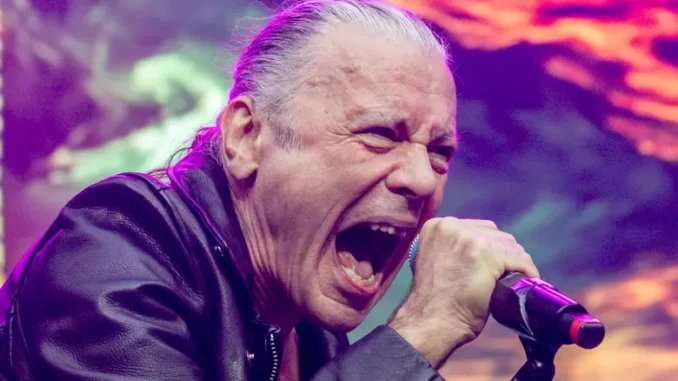
BREAKINGBREAKING NEWS: Bruce Dickinson Unveils Bold “Earth Resonance” Project, Blending Music, Science, and Healing. In a stunning announcement that has left both the music world and environmental communities buzzing, Iron Maidens lead singer Bruce Dickinson has revealed his most ambitious project yet: Earth Resonance, a groundbreaking initiative that combines live music with planetary healing technologies. Speaking at a surprise press event inside a specially built glass dome in Iceland, Martin explained that the project seeks to…see more ⬇️⬇️⬇️
BREAKING NEWS: Bruce Dickinson Unveils “Earth Resonance” — A Visionary Union of Music, Science, and Planetary Healing
By [Your Name] | Global Arts & Environment Correspondent
Reykjavík, Iceland — October 2025
In a breathtaking revelation that has electrified the global music and scientific communities, Bruce Dickinson, legendary frontman of Iron Maiden, has announced what may be the most daring and imaginative project of his storied career — “Earth Resonance.”
Described as a fusion of live music, environmental science, and planetary healing, the initiative seeks to transform sound itself into a tool for restoring harmony between humanity and the natural world.
At a surprise press conference held inside a giant, transparent dome structure just outside Reykjavík, Iceland — a nation long celebrated for its geothermal energy and pristine landscapes — Dickinson stood beneath shimmering aurora lights and declared:
> “For half a century, I’ve sung about humanity’s chaos, power, and fear. Now, it’s time to sing with the Earth — not just for it.”
Thus began the story of Earth Resonance: a bold and mysterious experiment at the intersection of metal, science, and metaphysics.
—
From Iron to Earth: The Evolution of a Frontman
Few artists have embodied the relentless spirit of rock like Bruce Dickinson. Pilot, fencer, historian, novelist, brewer, and, of course, the operatic voice of Iron Maiden — Dickinson has never been content with limits. But Earth Resonance marks his most personal and forward-thinking leap yet.
Those who know him best say this project has been brewing for years.
According to insiders, Dickinson began formulating the idea after Maiden’s “Future Past” world tour concluded in 2024. Exhausted yet inspired, he retreated to Iceland to rest and write new material. There, surrounded by volcanoes and endless silence, he began to reflect on a recurring question: “What if music could literally heal?”
> “I realized the planet itself has a rhythm,” Dickinson explained at the conference. “It hums. It vibrates. You can measure it in frequency — you can feel it beneath your feet. We’ve spent decades amplifying human noise, but we’ve forgotten to listen to Earth’s own music.”
That realization, he said, was the spark for a project that would combine the power of heavy metal with the precision of scientific resonance.
—
The Icelandic Dome: Humanity’s New Sound Cathedral
The announcement venue — a 120-meter-wide geodesic dome built from glass and basalt composites — is itself part of the Earth Resonance initiative.
Designed by renowned eco-architect Bjarke Ingels and engineered in partnership with ETH Zurich, the dome functions as both a concert space and an experimental laboratory.
Inside, a web of infrared sensors, magnetic transducers, and acoustic mirrors converts environmental energy — wind, seismic motion, even auroral radiation — into real-time sound. The result is a venue that “plays” the planet like an instrument.
> “This is not just a stage,” Dickinson said. “It’s a living amplifier.”
During the press event, attendees reported feeling subtle vibrations beneath their feet, as though the ground itself were humming. The dome, Dickinson explained, is tuned to 7.83 Hz — the Schumann Resonance, often referred to as the planet’s “heartbeat.”
“Every note we perform here,” he continued, “will resonate in harmony with that natural frequency.”
—
What Is “Earth Resonance”?
At its core, Earth Resonance is a multi-disciplinary mission uniting musicians, scientists, engineers, and healers in a shared pursuit: to explore how sound frequencies can restore ecological and psychological balance.
The project rests on three foundational pillars:
1. Resonant Composition: Creating music synchronized with Earth’s natural electromagnetic frequencies.
2. Vibrational Healing: Using targeted sound waves to promote mental wellness and, potentially, influence environmental processes like soil health and water purification.
3. Global Connection: Performing in environmentally significant locations — glaciers, deserts, rainforests — to foster awareness through immersive, low-impact concerts.
Unlike a typical Iron Maiden project, this one won’t feature roaring guitars or pyrotechnics — though Dickinson promises “moments of sheer sonic power.” Instead, Earth Resonance will blend ancient instruments, quantum sound modulation, and AI-driven harmonic synthesis.
“It’s not about volume,” he said with a grin. “It’s about vibration. Music that doesn’t just hit your ears — it moves through your bones and the ground beneath you.”
—
The Science Behind the Sound
To bridge the gap between mysticism and measurable science, Dickinson assembled an international coalition of experts known as The Resonance Collective.
Among its members:
Dr. Freyja Halldórsdóttir, Icelandic physicist and expert in vibrational field dynamics.
Dr. Robert M. Becker, neuroacoustic researcher from Oxford University.
Dr. Mayumi Tanaka, Japanese climatologist specializing in sound-wave interactions in ecosystems.
Brian Eno, the ambient music pioneer and sound designer, serving as “creative sonic advisor.”
Adrian Smith, Iron Maiden guitarist and lifelong collaborator, contributing musical and structural input.
The team’s research centers on how low-frequency waves — inaudible to the human ear — interact with the human body and natural systems. Studies have shown that sound can influence everything from heart rhythms to plant growth and even microbial regeneration in soil.
“Earth Resonance,” Dickinson emphasized, “isn’t pseudoscience — it’s frontier science.”
—
The Earth Resonance Orchestra: A Global Experiment in Harmony
Dickinson revealed plans for a rotating ensemble of musicians — dubbed the Earth Resonance Orchestra — featuring artists from diverse genres: metal, classical, folk, and world music.
Among those rumored to participate are Hans Zimmer, Lindsey Stirling, Anoushka Shankar, and Trent Reznor. Each will collaborate on site-specific compositions using environmental data as musical input.
For instance, a performance in the Sahara Desert might integrate wind frequency data, while a concert in the Amazon could use bioacoustic patterns from rainforest wildlife.
Each piece will be recorded using “Earth microphones” — ultra-sensitive seismic pickups that capture sub-audible frequencies generated by natural phenomena.
“Imagine the Earth itself joining the band,” Dickinson mused. “That’s what this is.”
—
Phase I: “Awakening” – The Icelandic Debut (2026)
The first official Earth Resonance event, titled “Awakening”, will take place in March 2026 inside the Icelandic dome.
Unlike a typical concert, “Awakening” will unfold as an immersive, ritualistic performance, merging sound, light, and environmental data in real time.
Highlights include:
A live symphonic-metal composition co-written by Dickinson and Zimmer, built around the rhythm of Icelandic tectonic activity.
Electromagnetic projections of the Northern Lights, visualized in sync with sonic pulses.
Audience biometric feedback, where heart rates and brainwave activity subtly shape the music’s tempo and tone.
A climactic vocal movement, in which Dickinson’s voice will merge with low-frequency Earth tones captured directly from beneath the venue.
Every watt of energy used will come from geothermal sources, and all ticket proceeds will fund reforestation projects in Africa and coral restoration in the Pacific.
—
Art Meets Ecology
Dickinson’s initiative extends beyond performance. The Earth Resonance Foundation — a nonprofit established alongside the project — will focus on ecological restoration, scientific outreach, and cultural education.
> “The stage is the seed,” he explained. “But the real goal is regeneration.”
Each concert site will host local sustainability workshops, employing regional scientists and students. In some cases, sound will even be used experimentally to stimulate microbial life in damaged soil — a concept being tested by Dr. Tanaka’s team.
> “Music has always moved people,” Dickinson said. “Now it might move ecosystems.”
—
From Heavy Metal to Healing Frequencies
When asked how fans of Iron Maiden might react to such a radical departure, Dickinson smiled knowingly.
“I’ve sung about Armageddon for 40 years,” he said. “Maybe it’s time to sing about renewal.”
That doesn’t mean Earth Resonance will abandon his signature theatrical flair. He hinted that Iron Maiden’s aesthetic — myth, history, and cosmic symbolism — will subtly infuse the performances.
Expect dramatic visual storytelling — projections of ancient alchemical symbols, planetary charts, and glowing “sound sigils” derived from frequency analysis.
> “It’ll feel like the heaviest show you’ve ever been to,” he said, “even if it’s quiet.”
—
A New Chapter in Environmental Art
Environmental art movements have existed for decades, but Earth Resonance represents a seismic shift: a rock icon wielding his global influence not to protest, but to resonate — to harmonize.
Music critics are calling it “the most ambitious artistic crossover since Pink Floyd’s The Wall.” Environmental scientists, meanwhile, see potential for awareness that transcends traditional activism.
Dr. Greta Jónsdóttir, environmental philosopher at the University of Iceland, remarked:
> “What Dickinson is doing isn’t just performance — it’s pedagogy. He’s teaching people to listen to the planet again.”
Even NASA’s Jet Propulsion Laboratory has expressed interest, proposing to share cosmic resonance data from deep-space probes for use in future compositions — potentially linking the Earth’s sounds to those of distant worlds.
—
Global Expansion: The Resonance Network
Following the Icelandic debut, Earth Resonance will expand across continents. Planned sites include:
Uluru, Australia: A desert performance in collaboration with Aboriginal elders, integrating didgeridoo harmonics and wind resonances.
Machu Picchu, Peru: A high-altitude soundscape using natural stone echo chambers.
Namibia’s Skeleton Coast: A concert merging oceanic wave sounds with human choirs.
Antarctica: A “silent broadcast” performance where vibrations, not music, are transmitted through the ice sheet itself.
Each site will be designed to leave no physical trace, powered by portable solar and wind units, and live-streamed in 3D audio to millions worldwide.
> “This is not a tour,” Dickinson clarified. “It’s a pilgrimage.”
—
The Critics and the Counterpoint
While many have hailed the project as revolutionary, others are skeptical.
Some scientists caution that claims of planetary healing through sound remain speculative. Dr. Paul Ricci, an acoustics expert at MIT, said:
> “Sound can influence local ecosystems in minor ways, but large-scale healing is more poetic than physical.”
Environmental activists, too, have raised concerns about resource use for dome construction and travel. In response, Dickinson promised a net-zero commitment, citing offsets through renewable energy and reforestation partnerships.
> “If we’re talking about harmony,” he said, “we have to live it.”
—
Inside the Music: A New Kind of Metal
Early snippets of Earth Resonance recordings, shared privately with select journalists, reveal a startling soundscape. Gone are the galloping riffs of “The Trooper.” In their place: deep drones, choral harmonics, and ethereal vocals layered with seismic rumble.
Yet Dickinson’s voice — that unmistakable, soaring tenor — remains the anchor. In one track, titled “Pulse of the Stone”, his voice rises from a whisper to an elemental roar, blending with glacier sounds until indistinguishable from the wind itself.
> “This isn’t background music,” said Brian Eno. “It’s geological music.”
—
Personal Transformation: Dickinson’s New Mission
For Bruce Dickinson, Earth Resonance isn’t just an artistic endeavor — it’s a personal evolution.
He spoke candidly about surviving tongue cancer a decade earlier and how it altered his view of energy and healing.
> “When you’ve faced your own mortality,” he said, “you start to see vibration — life — differently. Music saved me. Maybe now, I can return the favor to the planet.”
Friends describe him as more contemplative, more spiritual — though still fiercely intellectual and wryly humorous.
> “I’m still the same bloke,” he said. “I just swapped jet engines for frequency fields.”
—
Legacy in Motion
The Earth Resonance Foundation is already developing educational materials and youth programs encouraging students to experiment with sound and sustainability. Schools in the UK and Iceland will pilot Resonance Labs, where children learn to record and analyze environmental audio data.
An accompanying documentary series, directed by filmmaker Werner Herzog, will chronicle the project’s creation — from the dome’s construction to the debut concert — exploring humanity’s enduring fascination with vibration and cosmic order.
Herzog called the project “a rare act of planetary courage.”
—
A Resonant Future
As the press conference concluded, Dickinson returned to the stage. Behind him, the dome’s glass walls flickered with images of the Earth seen from orbit — silent, fragile, alive.
He lifted his arms and spoke softly, his voice echoing in the resonant chamber:
> “The Earth doesn’t need saving — it needs synchronizing.
We’ve forgotten our key.
Let’s tune ourselves — and find it again.”
Then, as if on cue, a deep rumble rolled beneath the dome — not thunder, but the vibration of the Earth itself, amplified and harmonized through the dome’s structure. Dickinson smiled, closed his eyes, and began to sing — a long, haunting note that BREAKING NEWS: Bruce Dickinson Unveils “Earth Resonance” — A Visionary Union of Music, Science, and Planetary Healing
By [Your Name] | Global Arts & Environment Correspondent
Reykjavík, Iceland — October 2025
In a breathtaking revelation that has electrified the global music and scientific communities, Bruce Dickinson, legendary frontman of Iron Maiden, has announced what may be the most daring and imaginative project of his storied career — “Earth Resonance.”
Described as a fusion of live music, environmental science, and planetary healing, the initiative seeks to transform sound itself into a tool for restoring harmony between humanity and the natural world.
At a surprise press conference held inside a giant, transparent dome structure just outside Reykjavík, Iceland — a nation long celebrated for its geothermal energy and pristine landscapes — Dickinson stood beneath shimmering aurora lights and declared:
> “For half a century, I’ve sung about humanity’s chaos, power, and fear. Now, it’s time to sing with the Earth — not just for it.”
Thus began the story of Earth Resonance: a bold and mysterious experiment at the intersection of metal, science, and metaphysics.
—
From Iron to Earth: The Evolution of a Frontman
Few artists have embodied the relentless spirit of rock like Bruce Dickinson. Pilot, fencer, historian, novelist, brewer, and, of course, the operatic voice of Iron Maiden — Dickinson has never been content with limits. But Earth Resonance marks his most personal and forward-thinking leap yet.
Those who know him best say this project has been brewing for years.
According to insiders, Dickinson began formulating the idea after Maiden’s “Future Past” world tour concluded in 2024. Exhausted yet inspired, he retreated to Iceland to rest and write new material. There, surrounded by volcanoes and endless silence, he began to reflect on a recurring question: “What if music could literally heal?”
> “I realized the planet itself has a rhythm,” Dickinson explained at the conference. “It hums. It vibrates. You can measure it in frequency — you can feel it beneath your feet. We’ve spent decades amplifying human noise, but we’ve forgotten to listen to Earth’s own music.”
That realization, he said, was the spark for a project that would combine the power of heavy metal with the precision of scientific resonance.
—
The Icelandic Dome: Humanity’s New Sound Cathedral
The announcement venue — a 120-meter-wide geodesic dome built from glass and basalt composites — is itself part of the Earth Resonance initiative.
Designed by renowned eco-architect Bjarke Ingels and engineered in partnership with ETH Zurich, the dome functions as both a concert space and an experimental laboratory.
Inside, a web of infrared sensors, magnetic transducers, and acoustic mirrors converts environmental energy — wind, seismic motion, even auroral radiation — into real-time sound. The result is a venue that “plays” the planet like an instrument.
> “This is not just a stage,” Dickinson said. “It’s a living amplifier.”
During the press event, attendees reported feeling subtle vibrations beneath their feet, as though the ground itself were humming. The dome, Dickinson explained, is tuned to 7.83 Hz — the Schumann Resonance, often referred to as the planet’s “heartbeat.”
“Every note we perform here,” he continued, “will resonate in harmony with that natural frequency.”
—
What Is “Earth Resonance”?
At its core, Earth Resonance is a multi-disciplinary mission uniting musicians, scientists, engineers, and healers in a shared pursuit: to explore how sound frequencies can restore ecological and psychological balance.
The project rests on three foundational pillars:
1. Resonant Composition: Creating music synchronized with Earth’s natural electromagnetic frequencies.
2. Vibrational Healing: Using targeted sound waves to promote mental wellness and, potentially, influence environmental processes like soil health and water purification.
3. Global Connection: Performing in environmentally significant locations — glaciers, deserts, rainforests — to foster awareness through immersive, low-impact concerts.
Unlike a typical Iron Maiden project, this one won’t feature roaring guitars or pyrotechnics — though Dickinson promises “moments of sheer sonic power.” Instead, Earth Resonance will blend ancient instruments, quantum sound modulation, and AI-driven harmonic synthesis.
“It’s not about volume,” he said with a grin. “It’s about vibration. Music that doesn’t just hit your ears — it moves through your bones and the ground beneath you.”
—
The Science Behind the Sound
To bridge the gap between mysticism and measurable science, Dickinson assembled an international coalition of experts known as The Resonance Collective.
Among its members:
Dr. Freyja Halldórsdóttir, Icelandic physicist and expert in vibrational field dynamics.
Dr. Robert M. Becker, neuroacoustic researcher from Oxford University.
Dr. Mayumi Tanaka, Japanese climatologist specializing in sound-wave interactions in ecosystems.
Brian Eno, the ambient music pioneer and sound designer, serving as “creative sonic advisor.”
Adrian Smith, Iron Maiden guitarist and lifelong collaborator, contributing musical and structural input.
The team’s research centers on how low-frequency waves — inaudible to the human ear — interact with the human body and natural systems. Studies have shown that sound can influence everything from heart rhythms to plant growth and even microbial regeneration in soil.
“Earth Resonance,” Dickinson emphasized, “isn’t pseudoscience — it’s frontier science.”
—
The Earth Resonance Orchestra: A Global Experiment in Harmony
Dickinson revealed plans for a rotating ensemble of musicians — dubbed the Earth Resonance Orchestra — featuring artists from diverse genres: metal, classical, folk, and world music.
Among those rumored to participate are Hans Zimmer, Lindsey Stirling, Anoushka Shankar, and Trent Reznor. Each will collaborate on site-specific compositions using environmental data as musical input.
For instance, a performance in the Sahara Desert might integrate wind frequency data, while a concert in the Amazon could use bioacoustic patterns from rainforest wildlife.
Each piece will be recorded using “Earth microphones” — ultra-sensitive seismic pickups that capture sub-audible frequencies generated by natural phenomena.
“Imagine the Earth itself joining the band,” Dickinson mused. “That’s what this is.”
—
Phase I: “Awakening” – The Icelandic Debut (2026)
The first official Earth Resonance event, titled “Awakening”, will take place in March 2026 inside the Icelandic dome.
Unlike a typical concert, “Awakening” will unfold as an immersive, ritualistic performance, merging sound, light, and environmental data in real time.
Highlights include:
A live symphonic-metal composition co-written by Dickinson and Zimmer, built around the rhythm of Icelandic tectonic activity.
Electromagnetic projections of the Northern Lights, visualized in sync with sonic pulses.
Audience biometric feedback, where heart rates and brainwave activity subtly shape the music’s tempo and tone.
A climactic vocal movement, in which Dickinson’s voice will merge with low-frequency Earth tones captured directly from beneath the venue.
Every watt of energy used will come from geothermal sources, and all ticket proceeds will fund reforestation projects in Africa and coral restoration in the Pacific.
—
Art Meets Ecology
Dickinson’s initiative extends beyond performance. The Earth Resonance Foundation — a nonprofit established alongside the project — will focus on ecological restoration, scientific outreach, and cultural education.
> “The stage is the seed,” he explained. “But the real goal is regeneration.”
Each concert site will host local sustainability workshops, employing regional scientists and students. In some cases, sound will even be used experimentally to stimulate microbial life in damaged soil — a concept being tested by Dr. Tanaka’s team.
> “Music has always moved people,” Dickinson said. “Now it might move ecosystems.”
—
From Heavy Metal to Healing Frequencies
When asked how fans of Iron Maiden might react to such a radical departure, Dickinson smiled knowingly.
“I’ve sung about Armageddon for 40 years,” he said. “Maybe it’s time to sing about renewal.”
That doesn’t mean Earth Resonance will abandon his signature theatrical flair. He hinted that Iron Maiden’s aesthetic — myth, history, and cosmic symbolism — will subtly infuse the performances.
Expect dramatic visual storytelling — projections of ancient alchemical symbols, planetary charts, and glowing “sound sigils” derived from frequency analysis.
> “It’ll feel like the heaviest show you’ve ever been to,” he said, “even if it’s quiet.”
—
A New Chapter in Environmental Art
Environmental art movements have existed for decades, but Earth Resonance represents a seismic shift: a rock icon wielding his global influence not to protest, but to resonate — to harmonize.
Music critics are calling it “the most ambitious artistic crossover since Pink Floyd’s The Wall.” Environmental scientists, meanwhile, see potential for awareness that transcends traditional activism.
Dr. Greta Jónsdóttir, environmental philosopher at the University of Iceland, remarked:
> “What Dickinson is doing isn’t just performance — it’s pedagogy. He’s teaching people to listen to the planet again.”
Even NASA’s Jet Propulsion Laboratory has expressed interest, proposing to share cosmic resonance data from deep-space probes for use in future compositions — potentially linking the Earth’s sounds to those of distant worlds.
—
Global Expansion: The Resonance Network
Following the Icelandic debut, Earth Resonance will expand across continents. Planned sites include:
Uluru, Australia: A desert performance in collaboration with Aboriginal elders, integrating didgeridoo harmonics and wind resonances.
Machu Picchu, Peru: A high-altitude soundscape using natural stone echo chambers.
Namibia’s Skeleton Coast: A concert merging oceanic wave sounds with human choirs.
Antarctica: A “silent broadcast” performance where vibrations, not music, are transmitted through the ice sheet itself.
Each site will be designed to leave no physical trace, powered by portable solar and wind units, and live-streamed in 3D audio to millions worldwide.
> “This is not a tour,” Dickinson clarified. “It’s a pilgrimage.”
—
The Critics and the Counterpoint
While many have hailed the project as revolutionary, others are skeptical.
Some scientists caution that claims of planetary healing through sound remain speculative. Dr. Paul Ricci, an acoustics expert at MIT, said:
> “Sound can influence local ecosystems in minor ways, but large-scale healing is more poetic than physical.”
Environmental activists, too, have raised concerns about resource use for dome construction and travel. In response, Dickinson promised a net-zero commitment, citing offsets through renewable energy and reforestation partnerships.
> “If we’re talking about harmony,” he said, “we have to live it.”
—
Inside the Music: A New Kind of Metal
Early snippets of Earth Resonance recordings, shared privately with select journalists, reveal a startling soundscape. Gone are the galloping riffs of “The Trooper.” In their place: deep drones, choral harmonics, and ethereal vocals layered with seismic rumble.
Yet Dickinson’s voice — that unmistakable, soaring tenor — remains the anchor. In one track, titled “Pulse of the Stone”, his voice rises from a whisper to an elemental roar, blending with glacier sounds until indistinguishable from the wind itself.
> “This isn’t background music,” said Brian Eno. “It’s geological music.”
—
Personal Transformation: Dickinson’s New Mission
For Bruce Dickinson, Earth Resonance isn’t just an artistic endeavor — it’s a personal evolution.
He spoke candidly about surviving tongue cancer a decade earlier and how it altered his view of energy and healing.
> “When you’ve faced your own mortality,” he said, “you start to see vibration — life — differently. Music saved me. Maybe now, I can return the favor to the planet.”
Friends describe him as more contemplative, more spiritual — though still fiercely intellectual and wryly humorous.
> “I’m still the same bloke,” he said. “I just swapped jet engines for frequency fields.”
—
Legacy in Motion
The Earth Resonance Foundation is already developing educational materials and youth programs encouraging students to experiment with sound and sustainability. Schools in the UK and Iceland will pilot Resonance Labs, where children learn to record and analyze environmental audio data.
An accompanying documentary series, directed by filmmaker Werner Herzog, will chronicle the project’s creation — from the dome’s construction to the debut concert — exploring humanity’s enduring fascination with vibration and cosmic order.
Herzog called the project “a rare act of planetary courage.”
—
A Resonant Future
As the press conference concluded, Dickinson returned to the stage. Behind him, the dome’s glass walls flickered with images of the Earth seen from orbit — silent, fragile, alive.
He lifted his arms and spoke softly, his voice echoing in the resonant chamber:
> “The Earth doesn’t need saving — it needs synchronizing.
We’ve forgotten our key.
Let’s tune ourselves — and find it again.”
Then, as if on cue, a deep rumble rolled beneath the dome — not thunder, but the vibration of the Earth itself, amplified and harmonized through the dome’s structure. Dickinson smiled, closed his eyes, and began to sing — a long, haunting note that BREAKING NEWS: Bruce Dickinson Unveils “Earth Resonance” — A Visionary Union of Music, Science, and Planetary Healing
By [Your Name] | Global Arts & Environment Correspondent
Reykjavík, Iceland — October 2025
In a breathtaking revelation that has electrified the global music and scientific communities, Bruce Dickinson, legendary frontman of Iron Maiden, has announced what may be the most daring and imaginative project of his storied career — “Earth Resonance.”
Described as a fusion of live music, environmental science, and planetary healing, the initiative seeks to transform sound itself into a tool for restoring harmony between humanity and the natural world.
At a surprise press conference held inside a giant, transparent dome structure just outside Reykjavík, Iceland — a nation long celebrated for its geothermal energy and pristine landscapes — Dickinson stood beneath shimmering aurora lights and declared:
> “For half a century, I’ve sung about humanity’s chaos, power, and fear. Now, it’s time to sing with the Earth — not just for it.”
Thus began the story of Earth Resonance: a bold and mysterious experiment at the intersection of metal, science, and metaphysics.
—
From Iron to Earth: The Evolution of a Frontman
Few artists have embodied the relentless spirit of rock like Bruce Dickinson. Pilot, fencer, historian, novelist, brewer, and, of course, the operatic voice of Iron Maiden — Dickinson has never been content with limits. But Earth Resonance marks his most personal and forward-thinking leap yet.
Those who know him best say this project has been brewing for years.
According to insiders, Dickinson began formulating the idea after Maiden’s “Future Past” world tour concluded in 2024. Exhausted yet inspired, he retreated to Iceland to rest and write new material. There, surrounded by volcanoes and endless silence, he began to reflect on a recurring question: “What if music could literally heal?”
> “I realized the planet itself has a rhythm,” Dickinson explained at the conference. “It hums. It vibrates. You can measure it in frequency — you can feel it beneath your feet. We’ve spent decades amplifying human noise, but we’ve forgotten to listen to Earth’s own music.”
That realization, he said, was the spark for a project that would combine the power of heavy metal with the precision of scientific resonance.
—
The Icelandic Dome: Humanity’s New Sound Cathedral
The announcement venue — a 120-meter-wide geodesic dome built from glass and basalt composites — is itself part of the Earth Resonance initiative.
Designed by renowned eco-architect Bjarke Ingels and engineered in partnership with ETH Zurich, the dome functions as both a concert space and an experimental laboratory.
Inside, a web of infrared sensors, magnetic transducers, and acoustic mirrors converts environmental energy — wind, seismic motion, even auroral radiation — into real-time sound. The result is a venue that “plays” the planet like an instrument.
> “This is not just a stage,” Dickinson said. “It’s a living amplifier.”
During the press event, attendees reported feeling subtle vibrations beneath their feet, as though the ground itself were humming. The dome, Dickinson explained, is tuned to 7.83 Hz — the Schumann Resonance, often referred to as the planet’s “heartbeat.”
“Every note we perform here,” he continued, “will resonate in harmony with that natural frequency.”
—
What Is “Earth Resonance”?
At its core, Earth Resonance is a multi-disciplinary mission uniting musicians, scientists, engineers, and healers in a shared pursuit: to explore how sound frequencies can restore ecological and psychological balance.
The project rests on three foundational pillars:
1. Resonant Composition: Creating music synchronized with Earth’s natural electromagnetic frequencies.
2. Vibrational Healing: Using targeted sound waves to promote mental wellness and, potentially, influence environmental processes like soil health and water purification.
3. Global Connection: Performing in environmentally significant locations — glaciers, deserts, rainforests — to foster awareness through immersive, low-impact concerts.
Unlike a typical Iron Maiden project, this one won’t feature roaring guitars or pyrotechnics — though Dickinson promises “moments of sheer sonic power.” Instead, Earth Resonance will blend ancient instruments, quantum sound modulation, and AI-driven harmonic synthesis.
“It’s not about volume,” he said with a grin. “It’s about vibration. Music that doesn’t just hit your ears — it moves through your bones and the ground beneath you.”
—
The Science Behind the Sound
To bridge the gap between mysticism and measurable science, Dickinson assembled an international coalition of experts known as The Resonance Collective.
Among its members:
Dr. Freyja Halldórsdóttir, Icelandic physicist and expert in vibrational field dynamics.
Dr. Robert M. Becker, neuroacoustic researcher from Oxford University.
Dr. Mayumi Tanaka, Japanese climatologist specializing in sound-wave interactions in ecosystems.
Brian Eno, the ambient music pioneer and sound designer, serving as “creative sonic advisor.”
Adrian Smith, Iron Maiden guitarist and lifelong collaborator, contributing musical and structural input.
The team’s research centers on how low-frequency waves — inaudible to the human ear — interact with the human body and natural systems. Studies have shown that sound can influence everything from heart rhythms to plant growth and even microbial regeneration in soil.
“Earth Resonance,” Dickinson emphasized, “isn’t pseudoscience — it’s frontier science.”
—
The Earth Resonance Orchestra: A Global Experiment in Harmony
Dickinson revealed plans for a rotating ensemble of musicians — dubbed the Earth Resonance Orchestra — featuring artists from diverse genres: metal, classical, folk, and world music.
Among those rumored to participate are Hans Zimmer, Lindsey Stirling, Anoushka Shankar, and Trent Reznor. Each will collaborate on site-specific compositions using environmental data as musical input.
For instance, a performance in the Sahara Desert might integrate wind frequency data, while a concert in the Amazon could use bioacoustic patterns from rainforest wildlife.
Each piece will be recorded using “Earth microphones” — ultra-sensitive seismic pickups that capture sub-audible frequencies generated by natural phenomena.
“Imagine the Earth itself joining the band,” Dickinson mused. “That’s what this is.”
—
Phase I: “Awakening” – The Icelandic Debut (2026)
The first official Earth Resonance event, titled “Awakening”, will take place in March 2026 inside the Icelandic dome.
Unlike a typical concert, “Awakening” will unfold as an immersive, ritualistic performance, merging sound, light, and environmental data in real time.
Highlights include:
A live symphonic-metal composition co-written by Dickinson and Zimmer, built around the rhythm of Icelandic tectonic activity.
Electromagnetic projections of the Northern Lights, visualized in sync with sonic pulses.
Audience biometric feedback, where heart rates and brainwave activity subtly shape the music’s tempo and tone.
A climactic vocal movement, in which Dickinson’s voice will merge with low-frequency Earth tones captured directly from beneath the venue.
Every watt of energy used will come from geothermal sources, and all ticket proceeds will fund reforestation projects in Africa and coral restoration in the Pacific.
—
Art Meets Ecology
Dickinson’s initiative extends beyond performance. The Earth Resonance Foundation — a nonprofit established alongside the project — will focus on ecological restoration, scientific outreach, and cultural education.
> “The stage is the seed,” he explained. “But the real goal is regeneration.”
Each concert site will host local sustainability workshops, employing regional scientists and students. In some cases, sound will even be used experimentally to stimulate microbial life in damaged soil — a concept being tested by Dr. Tanaka’s team.
> “Music has always moved people,” Dickinson said. “Now it might move ecosystems.”
—
From Heavy Metal to Healing Frequencies
When asked how fans of Iron Maiden might react to such a radical departure, Dickinson smiled knowingly.
“I’ve sung about Armageddon for 40 years,” he said. “Maybe it’s time to sing about renewal.”
That doesn’t mean Earth Resonance will abandon his signature theatrical flair. He hinted that Iron Maiden’s aesthetic — myth, history, and cosmic symbolism — will subtly infuse the performances.
Expect dramatic visual storytelling — projections of ancient alchemical symbols, planetary charts, and glowing “sound sigils” derived from frequency analysis.
> “It’ll feel like the heaviest show you’ve ever been to,” he said, “even if it’s quiet.”
—
A New Chapter in Environmental Art
Environmental art movements have existed for decades, but Earth Resonance represents a seismic shift: a rock icon wielding his global influence not to protest, but to resonate — to harmonize.
Music critics are calling it “the most ambitious artistic crossover since Pink Floyd’s The Wall.” Environmental scientists, meanwhile, see potential for awareness that transcends traditional activism.
Dr. Greta Jónsdóttir, environmental philosopher at the University of Iceland, remarked:
> “What Dickinson is doing isn’t just performance — it’s pedagogy. He’s teaching people to listen to the planet again.”
Even NASA’s Jet Propulsion Laboratory has expressed interest, proposing to share cosmic resonance data from deep-space probes for use in future compositions — potentially linking the Earth’s sounds to those of distant worlds.
—
Global Expansion: The Resonance Network
Following the Icelandic debut, Earth Resonance will expand across continents. Planned sites include:
Uluru, Australia: A desert performance in collaboration with Aboriginal elders, integrating didgeridoo harmonics and wind resonances.
Machu Picchu, Peru: A high-altitude soundscape using natural stone echo chambers.
Namibia’s Skeleton Coast: A concert merging oceanic wave sounds with human choirs.
Antarctica: A “silent broadcast” performance where vibrations, not music, are transmitted through the ice sheet itself.
Each site will be designed to leave no physical trace, powered by portable solar and wind units, and live-streamed in 3D audio to millions worldwide.
> “This is not a tour,” Dickinson clarified. “It’s a pilgrimage.”
—
The Critics and the Counterpoint
While many have hailed the project as revolutionary, others are skeptical.
Some scientists caution that claims of planetary healing through sound remain speculative. Dr. Paul Ricci, an acoustics expert at MIT, said:
> “Sound can influence local ecosystems in minor ways, but large-scale healing is more poetic than physical.”
Environmental activists, too, have raised concerns about resource use for dome construction and travel. In response, Dickinson promised a net-zero commitment, citing offsets through renewable energy and reforestation partnerships.
> “If we’re talking about harmony,” he said, “we have to live it.”
—
Inside the Music: A New Kind of Metal
Early snippets of Earth Resonance recordings, shared privately with select journalists, reveal a startling soundscape. Gone are the galloping riffs of “The Trooper.” In their place: deep drones, choral harmonics, and ethereal vocals layered with seismic rumble.
Yet Dickinson’s voice — that unmistakable, soaring tenor — remains the anchor. In one track, titled “Pulse of the Stone”, his voice rises from a whisper to an elemental roar, blending with glacier sounds until indistinguishable from the wind itself.
> “This isn’t background music,” said Brian Eno. “It’s geological music.”
—
Personal Transformation: Dickinson’s New Mission
For Bruce Dickinson, Earth Resonance isn’t just an artistic endeavor — it’s a personal evolution.
He spoke candidly about surviving tongue cancer a decade earlier and how it altered his view of energy and healing.
> “When you’ve faced your own mortality,” he said, “you start to see vibration — life — differently. Music saved me. Maybe now, I can return the favor to the planet.”
Friends describe him as more contemplative, more spiritual — though still fiercely intellectual and wryly humorous.
> “I’m still the same bloke,” he said. “I just swapped jet engines for frequency fields.”
—
Legacy in Motion
The Earth Resonance Foundation is already developing educational materials and youth programs encouraging students to experiment with sound and sustainability. Schools in the UK and Iceland will pilot Resonance Labs, where children learn to record and analyze environmental audio data.
An accompanying documentary series, directed by filmmaker Werner Herzog, will chronicle the project’s creation — from the dome’s construction to the debut concert — exploring humanity’s enduring fascination with vibration and cosmic order.
Herzog called the project “a rare act of planetary courage.”
—
A Resonant Future
As the press conference concluded, Dickinson returned to the stage. Behind him, the dome’s glass walls flickered with images of the Earth seen from orbit — silent, fragile, alive.
He lifted his arms and spoke softly, his voice echoing in the resonant chamber:
> “The Earth doesn’t need saving — it needs synchronizing.
We’ve forgotten our key.
Let’s tune ourselves — and find it again.”
Then, as if on cue, a deep rumble rolled beneath the dome — not thunder, but the vibration of the Earth itself, amplified and harmonized through the dome’s structure. Dickinson smiled, closed his eyes, and began to sing — a long, haunting note that rose into the shimmering aurora.
For a moment, the boundaries between metal, science, and mystery blurred. The audience stood spellbound — witnessing not just a performance, but the birth of an idea:
that sound, the oldest language in existence, might still be the one that heals us all.rose into the shimmering aurora.
For a moment, the boundaries between metal, science, and mystery blurred. The audience stood spellbound — witnessing not just a performance, but the birth of an idea:
that sound, the oldest language in existence, might still be the one that heals us all.rose into the shimmering aurora.
For a moment, the boundaries between metal, science, and mystery blurred. The audience stood spellbound — witnessing not just a performance, but the birth of an idea:
that sound, the oldest language in existence, might still be the one that heals us all.
Leave a Reply